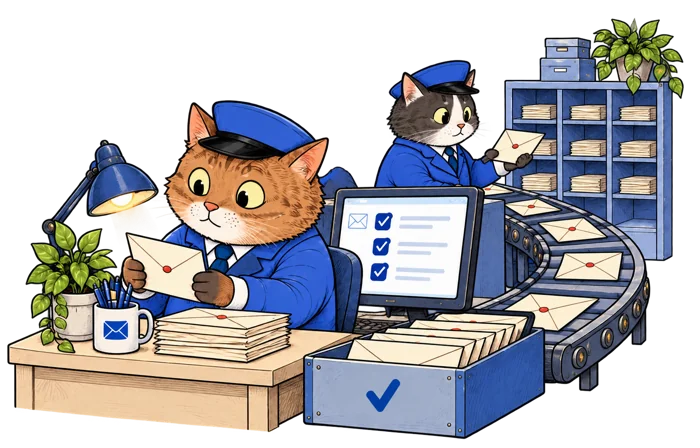
What is a catch-all email domain?
A catch-all email setup accepts mail addressed to otherwise unmatched names at a domain. That can be convenient for a business, but it makes individual mailbox verification less conclusive. Catch-all describes routing behaviour; it does not identify an inbox owner.
Open the relevant free tool →Two accepted names, one uncertain conclusion
A concrete example
Imagine a business with a real address, sales@company.example. If the server also accepts an arbitrary address like random-8274@company.example, it may be using catch-all routing. A verifier cannot infer from that acceptance that a person named Random has an account. The mail might reach a shared mailbox, pass to another system or be handled after the initial SMTP exchange.
Catch-all is a domain signal
Do not interpret “catch-all” as a typo in the address. The same behaviour can affect many different addresses at one domain. Keep the original contact and the domain-level finding in separate fields. This helps you avoid treating twenty contacts at one company as twenty independent confirmations of mailbox existence.
Decide based on your relationship
An existing customer at a catch-all domain may be a perfectly useful contact, especially if you have recent successful correspondence. An old, unconfirmed address at that domain has a different risk profile. Review the source, age, consent and delivery history before deciding what to do. A single catch-all label is too coarse to make that decision for every list.
Create a separate review segment
For a CSV import, preserve catch-all rows in their own segment rather than mixing them with hard failures or confirmed mailbox responses. Record the check date and the reason. If the address matters for an account, ask the user to confirm it through your own email flow. If it is a business contact, prefer a recently confirmed address supplied by that person over a guessed naming pattern.
Understand inconclusive tests
A random-address probe can be refused or deferred. In that case, catch-all status is unknown, not false. Some servers also vary their responses depending on connection reputation or current load. Repeated probing is not a reliable way to force certainty. Choose a bounded retry policy and keep the uncertainty visible to the people or agents using your data.
Put it into practice
- Keep catch-all separate from invalid.
- Use recent relationship and delivery evidence.
- Do not turn accepted random addresses into new contacts.
- Keep unknown catch-all tests unknown.