

Reviewing a sales contact
Use catch-all evidence to decide whether another confirmation method is needed.
Test whether a domain appears to accept mail for arbitrary addresses. We only label a domain catch-all when a randomly generated address is actually accepted.
A catch-all domain accepts messages addressed to names that may not correspond to a real inbox. That makes mailbox-level verification less certain because the receiving server can accept both genuine and invented recipients.
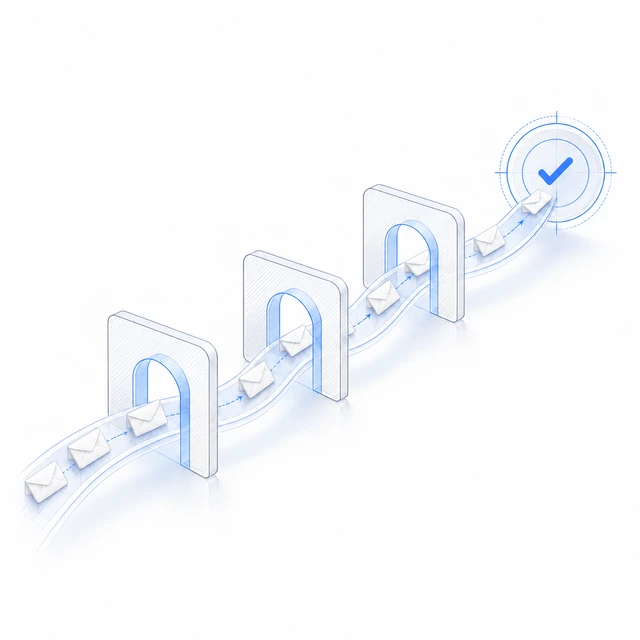
EmailValidly first checks the address and mail routing. When the target mailbox is accepted, it generates a random recipient at the same domain and asks the receiving server whether that address would also be accepted. If the random address is accepted, the domain is flagged as catch-all. If the random address is rejected, it is reported as not catch-all. Policy blocks and timeouts remain unknown.
A catch-all server may accept mail for recipients that were never created. This tool requests a recipient probe and, when the probe permits it, a random-recipient check to look for that behaviour.
The domain alone is not enough for this form.
Detected, not detected and unknown are three different outcomes.
A random recipient being accepted prevents a strong claim that the submitted mailbox exists.
Illustrative scenarios, not live results for the addresses or records shown. Open a scenario to see the next action.
The server accepted a made-up local part during the test.
Next action Review the address before relying on it.
The server distinguished the random recipient in this probe.
Next action Read the submitted mailbox result too.
The required evidence was not available; the random probe may not have run.
Next action Do not label the domain as catch-all or non-catch-all.
Use catch-all evidence to decide whether another confirmation method is needed.
Investigate why an address has usable DNS but no conclusive mailbox status.
Not necessarily. Some domains deliberately accept all recipients.
Yes. Acceptance during a probe is not a guarantee of final delivery.
Probes can be blocked, time out or stop before a random-recipient test can be attempted.